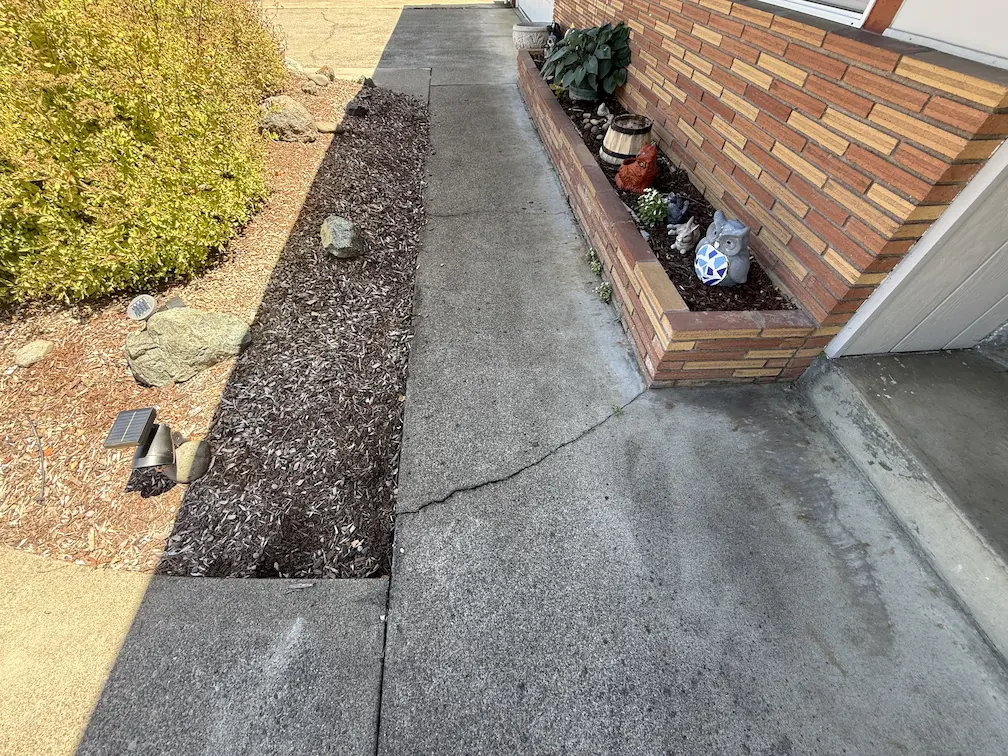
If you have a sinking sidewalk in Roseburg or a lopsided driveway in Eugene, you’ve likely realized that a full replacement is too expensive. In your search for a better solution, you’ve probably come across two main terms: Mudjacking and Polyjacking.
Both methods fall under the category of “slabjacking” or concrete lifting, but they use very different materials and techniques to achieve the same goal. At Oregon Concrete Leveling LLC, we believe in using the right tool for the specific job.
In this guide, we’ll break down the pros, cons, and best use cases for both methods so you can make an informed decision for your property.
What is Mudjacking? (The Traditional Powerhouse)
Mudjacking has been the industry standard for concrete repair for over 70 years. Despite the name, we don’t actually use “mud.” Instead, we use a “slurry”—a mixture of water, soil, sand, and Portland cement.
How it Works:
When you replace a concrete slab, you aren’t just paying for new material. You are paying for:
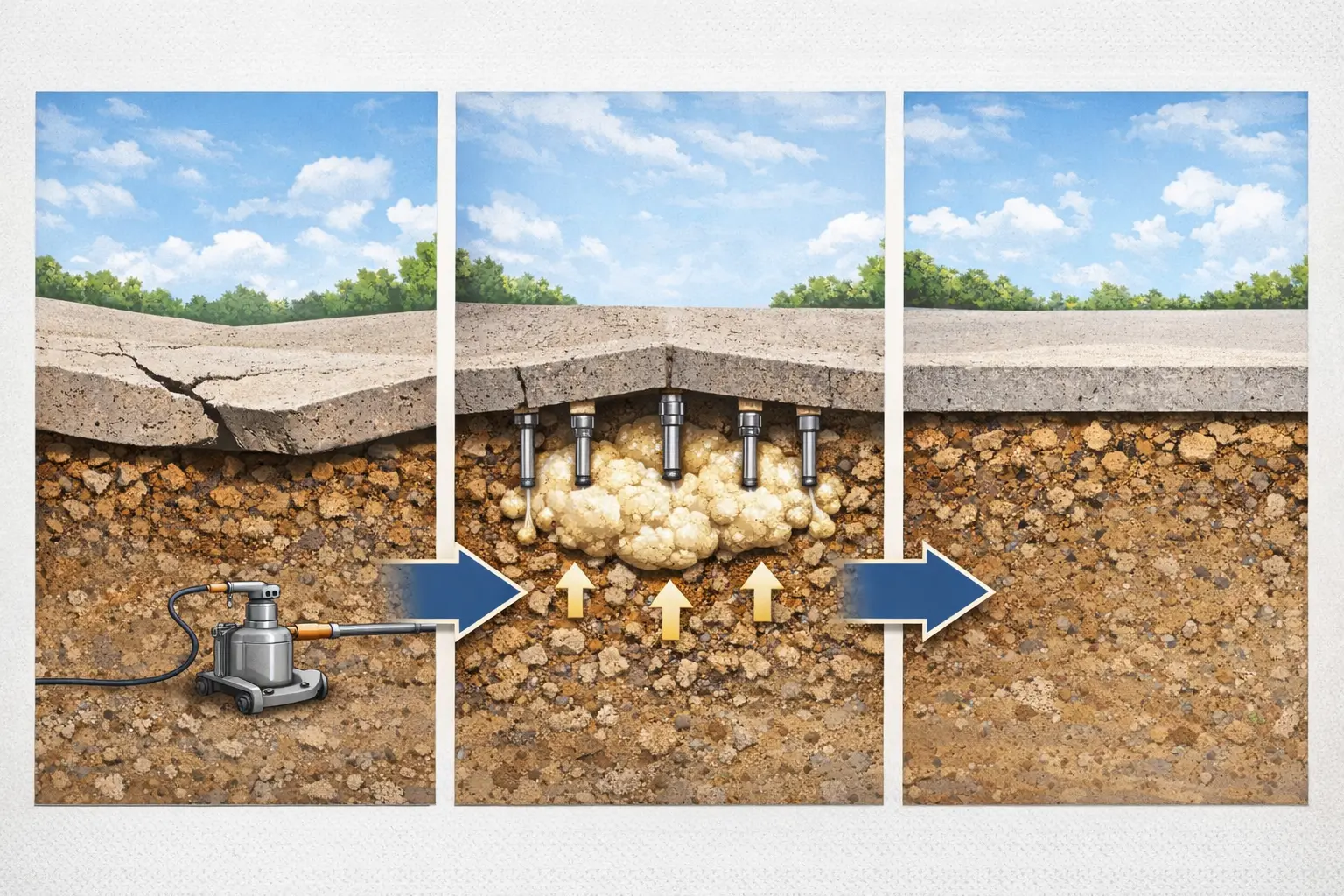
- Drilling: We drill holes (about 1.5 to 2 inches in diameter) into the sunken concrete slab.
- Pumping: The heavy slurry is pumped through these holes under high pressure.
- Lifting: As the slurry fills the voids beneath the concrete, it creates enough hydraulic pressure to lift the slab back to its original position.
- Patching: The holes are filled with a concrete plug.
The Pros:
- Cost-Effective: Mudjacking is generally the most affordable way to lift large sections of concrete.
- High Compressive Strength: Once the slurry hardens, it provides a very solid, rock-like base.
- Eco-Friendly: The materials are mostly natural (earth and cement).
The Cons:
- Weight: The slurry itself is very heavy. If the underlying soil is extremely soft or “muck-like,” the weight of the repair material can sometimes cause the soil to compress further over time.
- Hole Size: The injection holes are roughly the size of a soda can lid, which are more visible than polyjacking holes.
What is Polyjacking? (The Modern Precision Method)
Polyjacking (or Polyurethane Injection) is the “high-tech” version of concrete leveling. Instead of a heavy cement mixture, it uses a high-density, closed-cell expanding foam.
How it Works:
- Tiny Holes: We drill much smaller holes (about 5/8 of an inch)—roughly the size of a penny.
- Injection: A two-part liquid polymer is injected through the holes.
- Expansion: Almost immediately, the liquid undergoes a chemical reaction and expands into a rigid foam. This expansion is what provides the lifting force.
- Instant Cure: The foam reaches 90% of its full strength in less than 20 minutes.
The Pros:
- Lightweight: Polyurethane foam weighs about 2-4 pounds per cubic foot, compared to 100-150 pounds for mudjacking slurry. It won’t burden weak soil.
- Waterproof: The foam will never wash away, even in the heavy rains of Douglas County. It actually acts as a moisture barrier.
- Precision: Because the foam expands slowly and predictably, it’s perfect for sensitive areas like pool decks or interior floors.
The Cons:
- Price: The raw materials for polyurethane are more expensive than cement slurry, so the initial quote may be slightly higher.
Comparison at a Glance
| Feature | Mudjacking | Polyjacking |
| Primary Material | Cement/Soil Slurry | Polyurethane Foam |
| Drill Hole Size | 1.5″ – 2″ (Large) | 5/8″ (Small/Penny-sized) |
| Weight | Heavy (May compress soil) | Ultra-light (Won’t sink) |
| Cure Time | 24 Hours | 15 – 30 Minutes |
| Durability | High (Traditional) | Extreme (Waterproof) |
| Best For | Large Driveways, Budget Fixes | Pool Decks, Patios, Soft Soil |
Which Should You Choose?
Choose Mudjacking if…
You are a homeowner in Sutherlin or Winston on a budget and need to level a large driveway or a heavy garage floor where the underlying soil is already quite stable. It’s a tried-and-true method that has worked for decades.
Choose Polyjacking if…
You are dealing with sensitive areas. For example, if you have a sinking pool deck in Roseburg or a decorative patio in Eugene, the smaller holes and waterproof nature of polyjacking make it the superior choice. It’s also the go-to for commercial warehouses where “downtime” isn’t an option—you can drive a forklift over it 20 minutes after we finish.
Why Choose Oregon Concrete Leveling LLC?
At the end of the day, the “best” method depends on your specific soil conditions and the type of concrete you have. We don’t believe in a one-size-fits-all approach.
When you call us for a free estimate, we inspect the site, check for voids, and recommend the solution that will last the longest for your specific property in Lane or Douglas County.
Ready to stop tripping over that uneven concrete? Contact Oregon Concrete Leveling LLC today for your free inspection!